
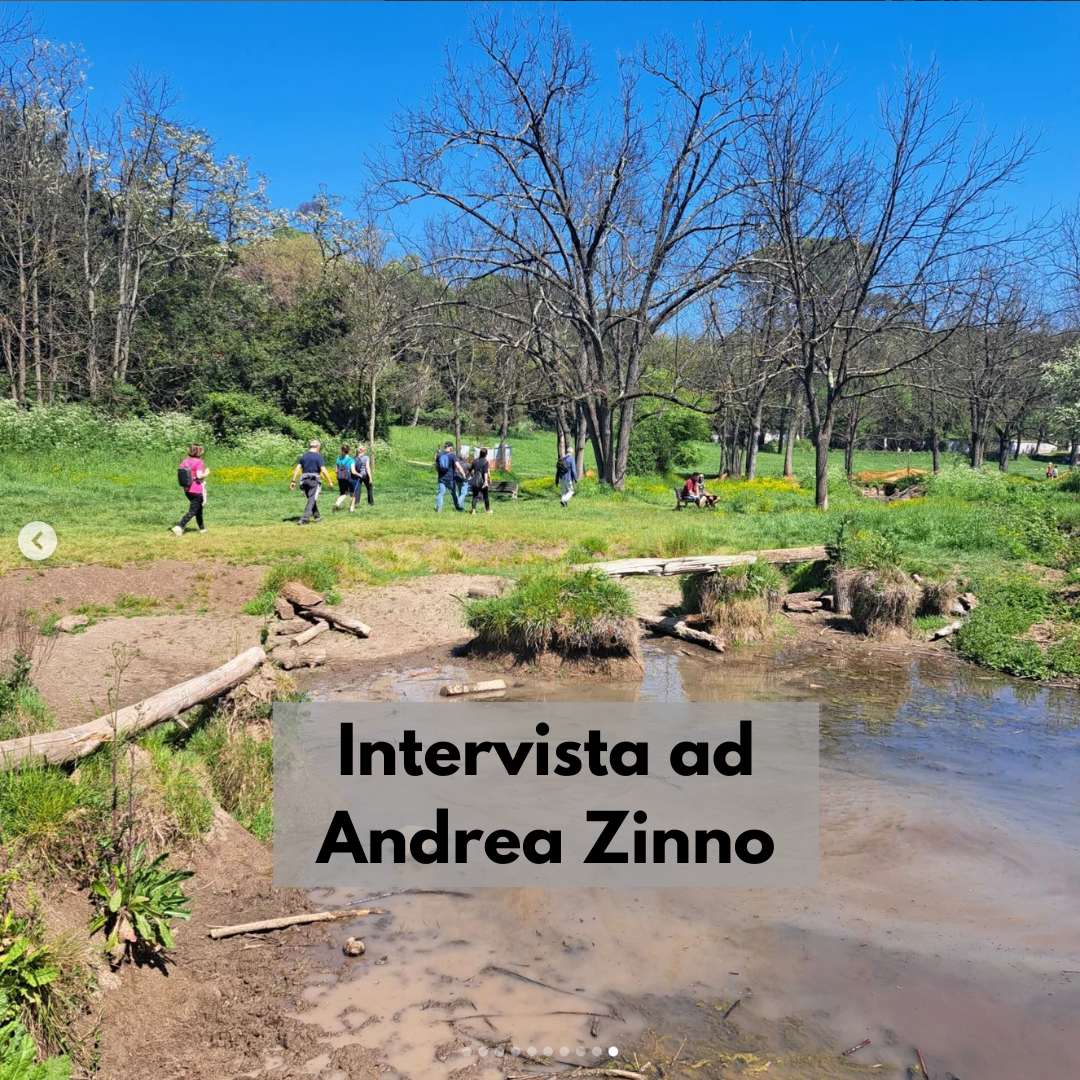
One of the greatest advantages of the BF Mountain SHOP's location is having Villa Ada Park just a five-minute walk away. Calling it a park is an understatement, and as you continue reading this article, you'll find out why.
The opportunity arose to organize an excursion that will allow us to discover all of Villa Ada together with Andrea Zinno, creator of the Facebook page Villa Ada Savoia and the YouTube channel > Villa Ada Savoia
Andrea had previously created this excursion together with other Villa Ada enthusiasts, and we wanted to offer it to you, our guests, too.
The hike will be approximately 10 km long, is free, and open to everyone, provided they have some walking experience. Space is available for a maximum of 20 people, and reservations must be made by WhatsApping 3479770595 or by joining the Facebook event at this link > https://bit.ly/4edkYFn

The hike will be done in a group setting, and everyone will be responsible for their own safety. The required equipment is trekking shoes, even low-cut ones, and even trail shoes with a lugged sole, along with a backpack with a spare shirt, at least one liter of water, some snacks, and a sun hat. The meeting point will be October 13, 2024, at the entrance to Villa Ada in Ponte Salario at 9:00 AM. We will return to the same starting point for lunch.
And now, an interview with Andrea Zinno!
BF: Hi Andrea, I'd like to thank you right away as a Roman citizen and especially as a resident of the Trieste/Africano neighborhood for creating the “Villa Ada Savoia” Facebook page and for the work you do to educate people about our beloved Villa.
How did your blogging activity dedicated to Villa Ada come about?
Andrea: As often happens, I'd say almost by chance. I practically grew up in Villa Ada, having been born and raised in the neighborhood and having also attended the Montessori Middle School, which for a few years was in the buildings where Legambiente is now located. Over time, of course, my attendance has been intermittent, but more recently, I'd say a couple of years ago,
Having started visiting it again, I had the idea of starting to tell about it, in its hidden places, in its conformation, in its history and, why not, in its mysteries.
The Facebook page was born this way, as a place for sharing, which was then followed by the YouTube channel and, finally, the Podcast “Villa Ada, history and stories”.
Ever more captivated by its charm, I began to study the villa systematically, dedicating myself to researching historical documentation in the Central State Archives, the State Archives of Rome, the Capitoline Archives, and, in general, in the minor sources that, in various capacities, preserve documentation relating to the villa.
BF: Can you briefly tell us its history? How did it begin and when did it become a citizen space?
Andrea: I would say the history of the villa begins between 1775 and 1789, when Prince Luigi Pallavicini purchased three vineyards—Saliceti, Capocaccia, and Calzamiglia—located in the area now between Via di Villa Ada and Via Chiana, effectively creating what we might call the embryonic stage of the villa. Pallavicini initiated important works, which led to the construction of the Temple of Flora, the Belvedere, and the pyramid adjacent to the Temple of Flora, which today has almost completely disappeared. In 1835, Pallavicini sold it to the Potenziani family, who did not undertake any significant renovations, and who then, in 1872, sold the villa to Vittorio Emanuele.
Emanuele II, who is credited with expanding the villa to its current size of approximately 160 hectares through a series of impressive acquisitions, and with constructing many of the buildings that still stand today. Upon the King's death, his son Umberto I sold the villa to Count Telfener, who also gave it the name "Villa Ada," chosen by the Count in honor of his wife, Ada Hungerford. The Count then sold it to his mother-in-law, who in turn sold it to the Banca Romana, which was subsequently engulfed in the well-known scandal. In 1904, Vittorio Emanuele III repurchased the villa, where he resided with his family until September 9, 1943, when he abandoned it.
With the transition from monarchy to republic, the King's assets were confiscated by the State (here the situation was actually more complex, due to the death of Vittorio Emanuele III a few days before the entry into force of the Italian Constitution, which included provisions relating to expropriation). Then, first in 1958 and then in 1996, the villa was opened to the public, after the necessary safety measures and excluding some buildings that are still privately owned, starting with the Royal Palace, purchased in 1997 by the Republic of Egypt for approximately 25 billion lire.
In what direction should local institutions work to maximize accessibility to this precious and historic green space?
Andrea: I believe the best way to enhance the villa and allow residents to experience it is to respect its unique, varied, and surprising conformation, without turning it into a simple park, which would lose its nature as an urban forest (Villa Ada is one of the largest urban forests in Europe, if not the largest).
Therefore, securing the remaining dangerous areas, as well as documenting them with guides and explanatory signs (as was done in the past). Restoration of the buildings, with a subsequent use that doesn't leave them abandoned again, but is consistent with the context (here the PNRR has provided a major boost, and much work has already begun).
For those who visit or wish to visit, it's important to always keep in mind the nature of the villa and its history, its morphological characteristics, its flora and fauna. As already mentioned, Villa Ada is more than just a park, but something more, something unique.
BF: Do you think residents could do more to prevent the degradation of certain areas? I'm thinking of the entire Ponte Salario area, where significant amounts of garbage are found along the road. Do you think an initiative like "Re-Take" could generate interest?
Andrea: Well, the first thing that comes to mind – and I'd say the most obvious – is to respect it, just as the city should be respected, because if there's rubbish it's because someone left it there...
Re-take initiatives are being undertaken, the most recent of which are in the area of Via di Ponte Salario and Forte Antenne, but we're talking about 160 hectares, with areas that are difficult to access.
I must also, unfortunately, add that, inside the villa and often in areas that are difficult to see and reach, there are often dumps of various types of waste, which give the clear impression of having been there for a long time.
BF: What are the most abandoned areas that could be revalued?
Andrea: First of all, I think it's necessary to understand what we mean by "abandoned" and "revalued", considering that, if we want to respect the villa for how it was born and developed, we must remember that some of its areas, first and foremost the Colle del Roccolo, have always been deliberately wild (the Colle del Roccolo was the Savoy hunting reserve, beneath which quarries and hypogea are hidden and if anyone has read "Let the party begin" by Niccolò Ammanniti, they will know what I'm talking about 😀 ), so any revaluation work must necessarily preserve its spirit and conformation.
There are of course other areas, which I wouldn't call abandoned, but simply hidden, difficult to reach, far from the usual paths, such as the Bosco della Regina Elena, on Monte Antenne, or the area adjacent to the wall that separates the villa from Via Panama, which, if indicated and documented, could become further destinations for excursions and walks .

BF: Your blog shows how attached and passionate you are to this place. What do you feel when you're at Villa Ada?
Andrea: Peace and tranquility, especially when I go there early in the morning; curiosity in always seeking out new and interesting things; disbelief and surprise when you discover things you wouldn't expect, like the ancient well, probably from the Etruscan or Roman era and still in practically perfect condition, that I discovered last year at Monte Antenne.
or the seventeenth-century cippi of the Company of the Most Holy Savior ad Sancta Sanctorum, discovered together with Lorenzo Grassi, coordinator of the Sherwood Observatory and companion on many explorations.
We at BF Mountain thank Andrea Zinno so much for this interview and for all his outreach work. He's truly a priceless asset. We're thrilled to offer you this excursion with him! See you on April 14th for those who can make it!
Below are the links where you can listen to, read, or watch Andrea Zinno's content: